
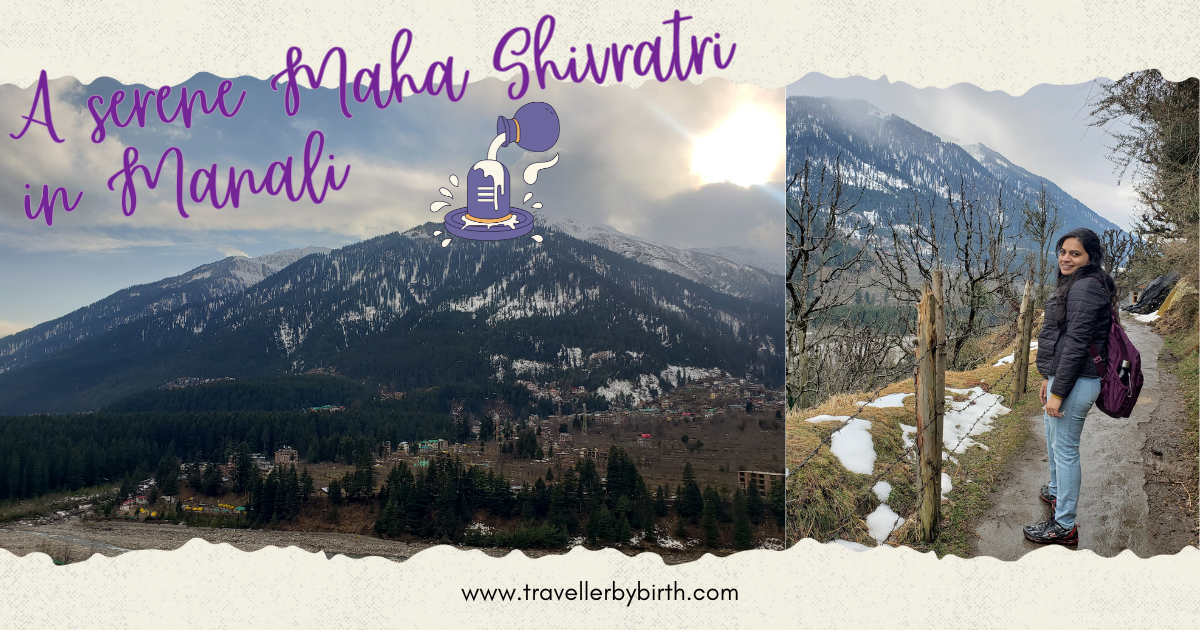
Nestled amidst the majestic Himalayas, I celebrated this divine festival by visiting the ancient temples of Siyali and Vashisht.
A huge cauldron was on fire. Two men were constantly brewing the contents with large ladles, while another man was adding ingredients to it. I recognised at once what was being prepared and that I was in for a treat.
It was my first time in the Himalayas during Maha Shivratri, the time when the snow begins to melt, but the temperature is only a couple of degrees above freezing point. I reached Manali from Ludhiana at around 7 pm, and the next day was the auspicious festival of Maha Shivratri. It was an unplanned holiday, so I looked for a nearby Mahadev Temple to visit in the morning, had pizza at Non-Stop Cafe for dinner and crashed for the night.
The morning was chillingly cold at 3° Celcius. I wrapped myself in warm layers and walked in search of the Siyali Mahadev Temple. It was only 2 km from my hotel. As I walked, I saw local devotees with plates of fresh pink roses and Bael leaves. I followed them, and soon, an opulent stone-brick gate welcomed me. Its roof was paved with stone slabs, and on the inside, it was decorated with wooden panels carved with the verse, “Satyam Shivam Sundaram”. I removed my shoes and entered the gate.
A stone statue of the sacred bull Nandi was being worshipped by women dressed in colourful sarees and sweaters. Milk and water trickled down from the feet of the bull towards the temple staircase. Saving my socks from it, I stood to admire the woodwork of the temple built in the famous Kath-Kuni architecture style of Himachal. This style mainly uses only stone and wood. The circumambulatory passage around the temple had lotus-engraved pillars on one side and wooden planks on the other side. These pillars were chiselled with patterns and placed horizontally between white stone walls. The ceiling was wooden—adorned with beautiful motifs.

There were goat heads with large horns hanging in the middle on all four sides of the temple. One of them was carved from wood. The others looked like taxidermy artworks. The goat heads are commonly seen across ancient structures in Himachal as symbols of sacrificial ceremonies. The temple looked stunning with minimal decor of garlands of marigolds and green leaves. It didn’t need any additional embellishments as the grounds were already adjoined with a lining of colourful Himachali houses and the stretch of towering snow-capped Himalayas as the backdrop.
Local men, adorned with their ochre Pahadi caps, were busy preparing for an evening feast behind the temple. The festivity was growing on me, and I didn’t feel like leaving the premises. Somehow, I pulled myself out and continued my Manali expedition. After exploring the Hidimba Temple and a forest sanctuary, I slurped a bowl of Thukpa, and later, took an auto to the Vashisht Village.
Named after the sage, Vashisht is a surreal town. It has a view of the jagged peaks of the Pir Panjal mountainscapes located behind the mighty flow of the Beas River. It is believed that the ancient 4000-year-old Lord Shiva temple in the serene town is the same spot where the saint meditated. The legend draws many locals and tourists to the temple during Maha Shivratri. Everyone desires a glimpse of Lord Shiva—to pray and seek His blessings, and I was one of them. Usually, I avoid crowds, but that day was different. I could feel the tranquillity spreading across the mountains and through the village. I placed my sneakers and socks on the shoe rack and climbed the temple steps.
The cobbled flooring was icy cold, scattered with snow crumbs. My feet went numb, but the spirit was still high. I found a dry spot on a bench and sat for a while to admire the energetic aura of the place. The archaic stone temple was newly enhanced with contemporary wooden designs. While I listened to the repeated chimes of the temple bell, I couldn’t believe my luck that I was celebrating the emergence of Lord Shiva in such a lively yet peaceful way.

My trail of thoughts was impeded by the aroma coming out of that huge cauldron. The day was starting to descend along with the temperature. I remembered that it was time for the distribution of the offering. The volunteers had already started serving hot prasad in paper cups. So, I waited in the queue and got hold of one of the steaming cups. It felt like a big bear hug in the cold weather. The cup was brimming with hot and sweet milk thickened with constant stirring. I could taste the spiciness of nutmeg, cinnamon and cardamom and the crunchiness of almond flakes and pistachios.
What made this Maha Shivratri prasad special was the traditional addition of a special ingredient called bhang. This is a green paste made from Indian cannabis. I chugged the thick liquid quickly and craved some more. With another glass in my hand, I cherished the unforgettable moment. This time, I took slow sips while enjoying the glorious views of the snow-coated summits of the mountains in front of me. Visiting two time-worn temples and guzzling that divine offering made my celebration of Maha Shivratri fulfilling. I reconnected with nature as well as the spiritual side of me. In my heart, I felt pangs of jealousy for the natives of Manali who get to savour these stunning views every day.
Leave a Reply