
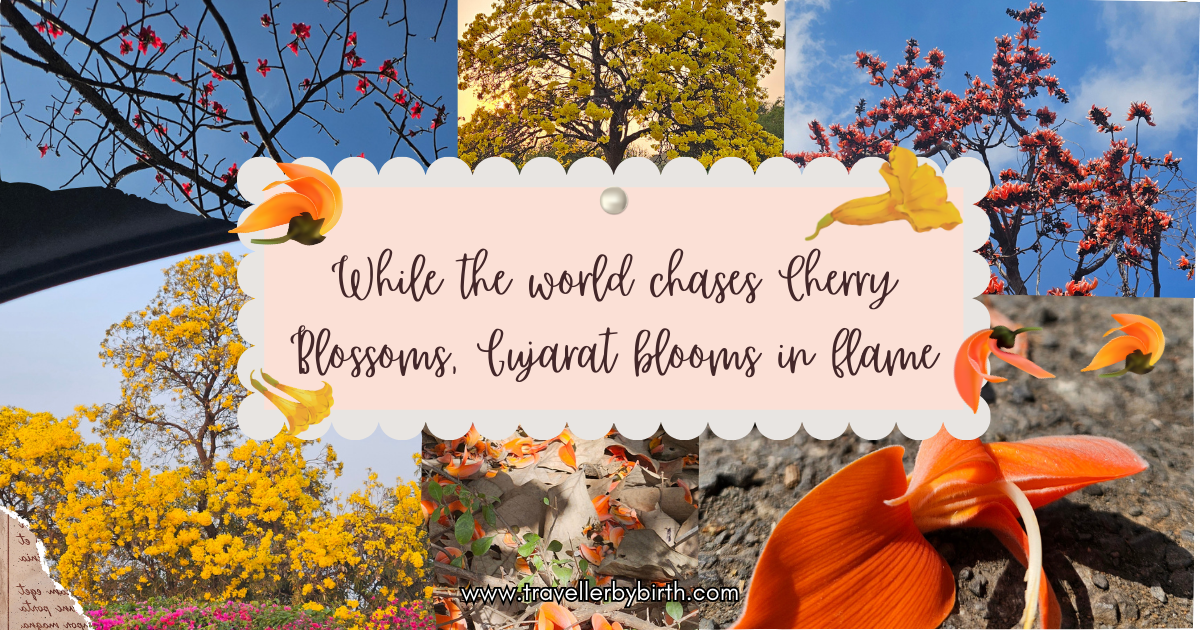
Beyond pinkish blossoms, Western India announces spring through its native flowering trees.
Every spring, the world turns its gaze to cherry blossoms. Travellers plan their itineraries around delicate pink blooms in Japan, South Korea, Washington DC, and increasingly parts of India such as Bengaluru.
But in Gujarat, spring flowers arrive in a very different palette.

Across highways, forests, and quiet neighbourhood streets, trees burst into colour — the fiery orange flames of palash, the crimson blooms of semal, and cascades of golden trumpet flowers spilling over avenues. For a few weeks, the landscape transforms into something unexpectedly vibrant, revealing a secret spring that most people don’t associate with Western India.
Spring in Gujarat isn’t cherry—it’s flame orange and gold. For locals who pay attention, these blooms are the most reliable sign that spring has arrived.
While the Instagrammers were busy chasing the pinks of the apple, apricot, and cherry blossoms, I decided to carve my own trail through the Palash trees. Their presence is undeniable across much of Northern India, especially in Jharkhand, but what many people miss is that they bloom just as abundantly in Gujarat’s tribal areas.
The Moment You Realise Spring Has Arrived
In Gujarat, spring rarely makes headlines. There are no bloom forecasts, curated viewing spots, or flower festivals. Instead, it reveals itself gradually.
One day, you are driving down a familiar road, and suddenly you catch a tree glowing orange against the dusty landscape.
This was exactly the moment I experienced during one of my road trips. Soon, I realised that Gujarat’s tribal belt from Dediapada to Dahod is a terrain favourable for Palash trees.
Once you spot one, you begin seeing them everywhere. It almost feels like the territory has been quietly preparing for spring all along.
The Flame of the Forest
Scientific Name: Butea monosperma
Among the most dramatic spring blooms is the Palash tree, known for its bright orange flowers that look like scattered flames across bare branches. In Gujarati, the tree is called Kesudo, derived from Kesari, meaning orange. As March arrives, and Holi knocks on the door, Kesudo begins to appear across forests and fields. According to religious belief, Radha and Krishna used to play Holi with these flowers, and even today, organic colours for the festival are prepared from them.

When soaked in water, the blossoms release a light herbaceous dye that turns the water pale orange. Traditionally, this infusion is used as a cooling sherbet when mixed with sugar. Many also believe the water has soothing properties for skin ailments during the changing weather.
Palash trees usually flower when their branches are leafless, making the blossoms appear even more striking. Seen against dry fields or along forest edges, the trees look as if they are burning in slow motion. A variety of Palash also blooms in vivid yellow, a rare sight that makes the name “Flame of the Forest” even more fitting.

Driving through rural Gujarat at this time of year (February-March), you will often see these trees scattered across roadside stretches. In search of them in greater numbers, we travelled through the forest belt of Surat district, crossing villages like Wadi, Kevdi, Umarpada, Zankhvav, and the road leading to Amli Dam. The tribal district of Dahod is equally blessed with these blooms.
For local communities, the tree holds practical value as well. Villagers are often seen collecting the fallen, parrot-beak-shaped blossoms from the forest and selling them in nearby city markets.
No wonder the spring in Gujarat turns theatrically orange, and you cannot ignore its vibrant presence.
The Towering Red of Semal
Scientific Name: Bombax ceiba
If Palash is fiery, Semal is poetic.
These tall trees bloom with large, crimson flowers that appear high above the ground, often before the leaves return. The effect is impressive — soaring silhouettes crowned with bold red blossoms against the open sky.

Later, when the flowers fall, they adorn the ground like bright red carpets. Eventually, when the tree produces elongated seed pods, they burst open to reveal soft cottony fibres used traditionally as pillow filling. This is how the tree earned the name “silk cotton tree.”
During its flowering season, the Semal tree commands attention. From afar, it can sometimes be mistaken for palash, but the deep red flowers and their large size quickly reveal the difference. Semal trees, also called as Shalmali, often stand isolated. They don’t collectively line the roads, but a single tree alongside is enough to dominate the scenery.

They are scattered across Gujarat’s countryside, often appearing in the same regions where palash grows, making it common to encounter both during the same journey.
Pavements Washed in Golden Yellow
Scientific Name: Tabebuia aurea
Then comes the cheerful arrival of the golden trumpet tree.
Unlike palash or semal, which often appear in forests or rural areas, golden trumpet trees, locally called Swarnapushpi, are common in cities. When they bloom, they transform ordinary streets into bright yellow corridors.
Walk beneath them, and you’ll notice the ground covered in fallen petals, as if someone has laid down a golden carpet.

In Gujarat, one particularly prominent stretch appears along the Vadodara–Ahmedabad Expressway. If you are driving from Vadodara towards Ahmedabad, keep an eye out after crossing the Anand exit. From the opposite direction, the blooms appear shortly after the Nadiad exit. For nearly two kilometres, the highway is densely lined with Golden Trumpet Trees on both sides, creating a luminescent passage when the trees are in full bloom. The vista feels cinematic already, and if you want to capture the outlook perfectly, cross the path when the sunlight hits the blossoms. This is when you can romance the spring.
And while golden trumpet trees take over the spring spectacle in Gujarat, you may occasionally come across the pink trumpet tree (Tabebuia rosea) here and there. Bengaluru receives much attention for these blossoms, but in Gujarat, they blush quietly, adding soft pink tones to a landscape already rich with orange, red, and yellow.

An Unplanned Spring
One of the most beautiful things about spring in Gujarat is that it doesn’t demand attention.
There are no crowded viewing points. No entry tickets. No tourist rush.
You might notice the blooms while riding a scooter through your neighbourhood, driving on a highway, or walking through a random street. The flowers appear where you least expect them — beside small shops, across village fields, or in the middle of city traffic.

Instead of travelling across continents to chase a bloom, you simply learn to notice the beauty that has always been growing around you.
Perhaps that is the real lesson these flowering trees offer.
While the delicate pink blossoms influence spring in the rest of the world, Gujarat celebrates the season with its own bold show — not in soft pastels, but in flames of orange, red, and gold.
All you have to do is look up.
Because somewhere above the familiar landscape, a palash tree might already be burning orange, a semal tree might be holding crimson flowers, or a golden trumpet tree might be showering petals onto the street below.
And just like that, spring in Gujarat begins.
Why These Trees Bloom Before the Leaves
One of the most fascinating things about many spring-flowering trees is that they bloom before their leaves return.
Take the palash or the semal, for instance. During late winter, these trees shed most of their foliage, leaving the branches lifeless. And then, suddenly, the flowers appear — bright orange flames on the palash and bold crimson blossoms on the semal.
The effect is dramatic because nothing competes with the flowers. Without leaves in the way, the blooms stand out sharply against the sky, making them visible from far away.
There is also a clever ecological reason behind this timing.
When the branches are bare, pollinators like birds and insects can easily spot the flowers and access their nectar. The bright colours and open visibility help attract them from a distance, increasing the chances of pollination.
Once the flowering period ends, the trees slowly begin to grow fresh leaves again, preparing for the long summer ahead.
In a way, this brief moment — when the branches hold only flowers and no leaves — the trees seem to exist purely for colour, turning wintry hues into colourful scenes that last only a few weeks before the wind carries them away. And then, just as quietly as they arrived, the blooms fade away, leaving behind green canopies for the summer landscape.
Leave a Reply